
Slide 1
First slide content
Slide 2
Second slide content
AB) Types of Health Insurance

One policy does not fit every life stage
Health needs change across individuals, families, parents, newborns, employees, and people facing high-cost illnesses.
POLICY TYPE | WHAT IT IS DESIGNED TO ADDRESS |
Individual | One person’s hospitalisation and healthcare needs |
Family floater | Shared cover for a couple or family |
Senior citizen | Later-life needs and age-specific underwriting |
Newborn | Early protection, often linked to a parent’s policy |
Maternity | Eligible pregnancy and delivery expenses |
Group | Employer- or organisation-sponsored cover |
Critical illness | A benefit after diagnosis of a listed condition |
Personal accident | Accidental death and disability risks |

Individual Health Insurance protects one person
An individual policy assigns a sum insured to one person. It may cover eligible hospitalisation expenses and related benefits according to the policy schedule. This can be useful when one person’s needs should not depend on a shared family limit.
WHO IT MAY SUIT
Single adults, salaried professionals, self-employed people, or anyone seeking additional personal cover.
CHECK BEFORE BUYING
Room-rent limits, co-pay, waiting periods, exclusions, restoration, network hospitals, and the claim process.
- A personal policy can complement employer cover, subject to its terms and limits.
02 / SHARED FAMILY COVER
ONE COVER.
SEVERAL MEMBERS.
A family floater lets one or more covered members use the same sum insured during the policy year.
A family floater lets one or more covered members use the same sum insured during the policy year.

03 / LATER-LIFE NEEDS
- Senior Citizen Health Insurance addresses later-life needs
- These policies are designed for older adults and may involve age-specific underwriting, co-payments, sub-limits, medical tests, and waiting periods. Dedicated protection can reduce reliance on a family floater, subject to eligibility and policy terms.
-
PRE-EXISTING DISEASES
Check the waiting period and the definition used.
COST SHARING
Understand co-pay and disease-specific sub-limits.
ROOM ELIGIBILITY
Confirm room rules and their effect on claims.
LONG-TERM ACCESS
Review renewability and any required medical tests.

04 / EARLY PROTECTION
Newborn Health Insurance starts protection early
Newborn cover may be included in a maternity benefit or added under a family health policy. Eligibility can depend on the baby’s age, enrolment window, congenital-condition wording, and the parent’s policy.
THE PRACTICAL CHECKLIST
- Newborn inclusion date and enrolment deadline
- Neonatal care and any vaccination benefit
- Congenital-condition wording and exclusions
- Documentation required for addition and claims
Read the parent policy and newborn benefit together. The schedule and wording govern.
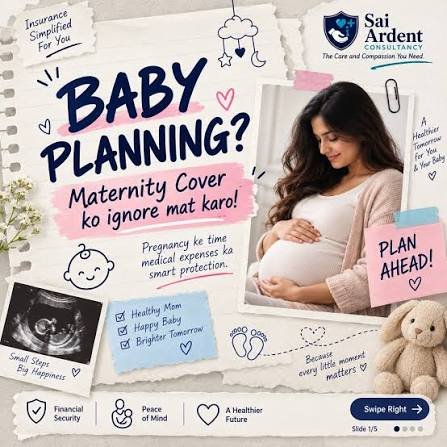
MATERNITY COVER
STARTS BEFORE
PREGNANCY.
Maternity Health Insurance plans ahead for pregnancy
Maternity cover may pay eligible pregnancy- and delivery-related expenses, subject to waiting periods, limits, exclusions, and other policy conditions. Couples planning a family may consider buying cover before pregnancy because an existing pregnancy may be excluded.
WAITING PERIOD
Confirm when maternity benefits become available.
DELIVERY LIMITS
Compare normal and caesarean delivery limits.
RELATED BENEFITS
Check newborn, pre- and post-natal expenses.
EXISTING PREGNANCY
Ask whether it is excluded under the wording.'
WAITING PERIOD
DELIVERY LIMITS
RELATED BENEFITS
EXISTING PREGNANCY
Group Health Insurance comes through an employer or organisation
Employer-sponsored group insurance can provide a base layer of protection for employees and, where offered, their dependants. The benefit is connected to the group arrangement, so it may not be enough for every family or medical event.